Automating the medical concierge
Contact Center Management (CCM) — a platform that automates the medical-concierge team's specialist recommendation and booking process for Southeast Asia's leading telemedicine provider.
From GP referral to confirmed specialist
My role — Lead Product Designer: product strategy, research & synthesis, journeys, MVP definition, user flows, validation & hi-fi design.
DoctorAnywhere (DA), Southeast Asia's top telemedicine provider, has clinics across Singapore. When a GP refers a patient to a specialist, the medical-concierge team (MCT) helps book and confirm the appointment.
Contact Center Management (CCM) centralizes all patient interactions, making a contact center easier to manage and operate. By streamlining the GP-to-specialist consultation process, CCM reduces costs and lifts customer satisfaction.
A booking process run on a spreadsheet
The MCT tracked every patient request inside a complex Excel sheet — fragile, manual and impossible to scale.
- High human-error rate from updating all requests in one complex spreadsheet.
- An average of 32% daily user complaints.
- 48% patient drop-off due to the time MCT took to complete a case.
- 89.5% of appointments couldn't be secured and proceeded.
Success metrics
- Appointment-request conversion: how many requests convert to confirmed appointments.
- Complaint rate: reduce daily patient complaints.
- Digitalise the manual flow: cut human error and time-to-complete per case.
- Support requests: reduce app-related support volume.
A hybrid, evidence-led approach
For most product decisions a hybrid approach works best: build a current-state map to understand existing opportunities, then a future-state map to envision new ideas holistically. Use a hypothesis-first map to build stakeholder buy-in, then follow up with user research to validate or evolve those assumptions into a second, evidence-based version.
Discovery — mapping how work happens today
- Mapped the current GP → specialist referral flow.
- Mapped the current GP → specialist cashless-insurance flow.
- Analysed the MCT team's data-collection Excel document.
- Understood current patient sources and escalation paths.
Build buy-in, then validate with users
From the current workflows I ran a workshop with stakeholders and created a hypothesis map across the key stages — case creation, case assessment and hospitalization — and validated it with them.
I then prepared a 15-question interview script focused on values, pain points, motivations and daily routines, and ran face-to-face interviews with 3 medical-concierge team members and 2 stakeholders — refining the hypotheses and assumptions against what I heard.
Current-state & future-state journeys
Current-state journey maps visualise the experience customers have trying to reach a goal with the product as it exists today. Future-state maps visualise the ideal journey that doesn't exist yet — the target we designed toward.
Sketches to validated wireframes
Before any pixels, I developed the end-to-end user flow and validated it with stakeholders and the medical-concierge team — confirming each decision point, status change and handoff held up against how cases actually move.
With the flow locked, in Miro I translated first sketches into low-fidelity wireframes, ran a moderate usability test with stakeholders, and used the findings to enhance the lo-fi and validate again before locking the final version.
A case-and-ticket model for agents
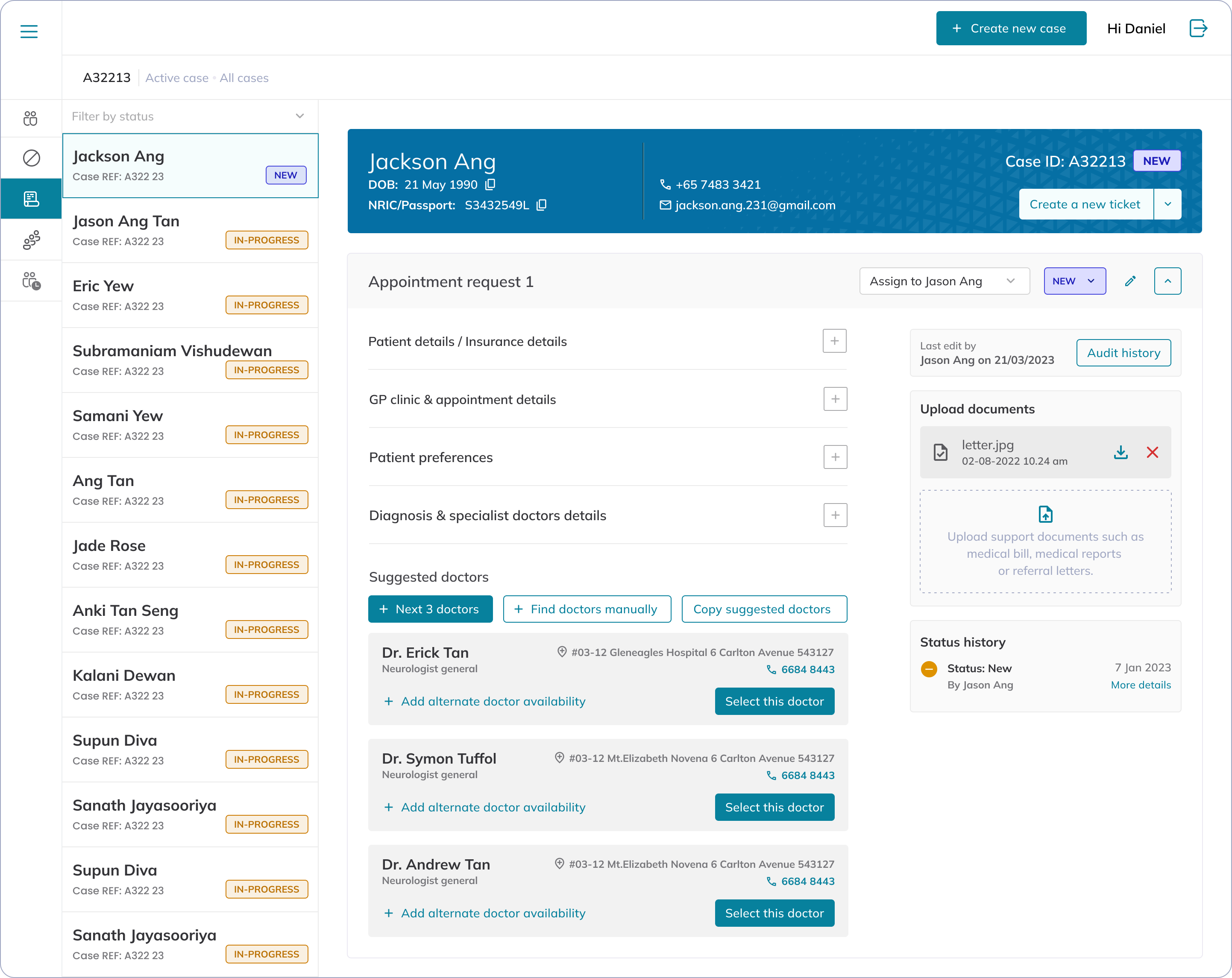
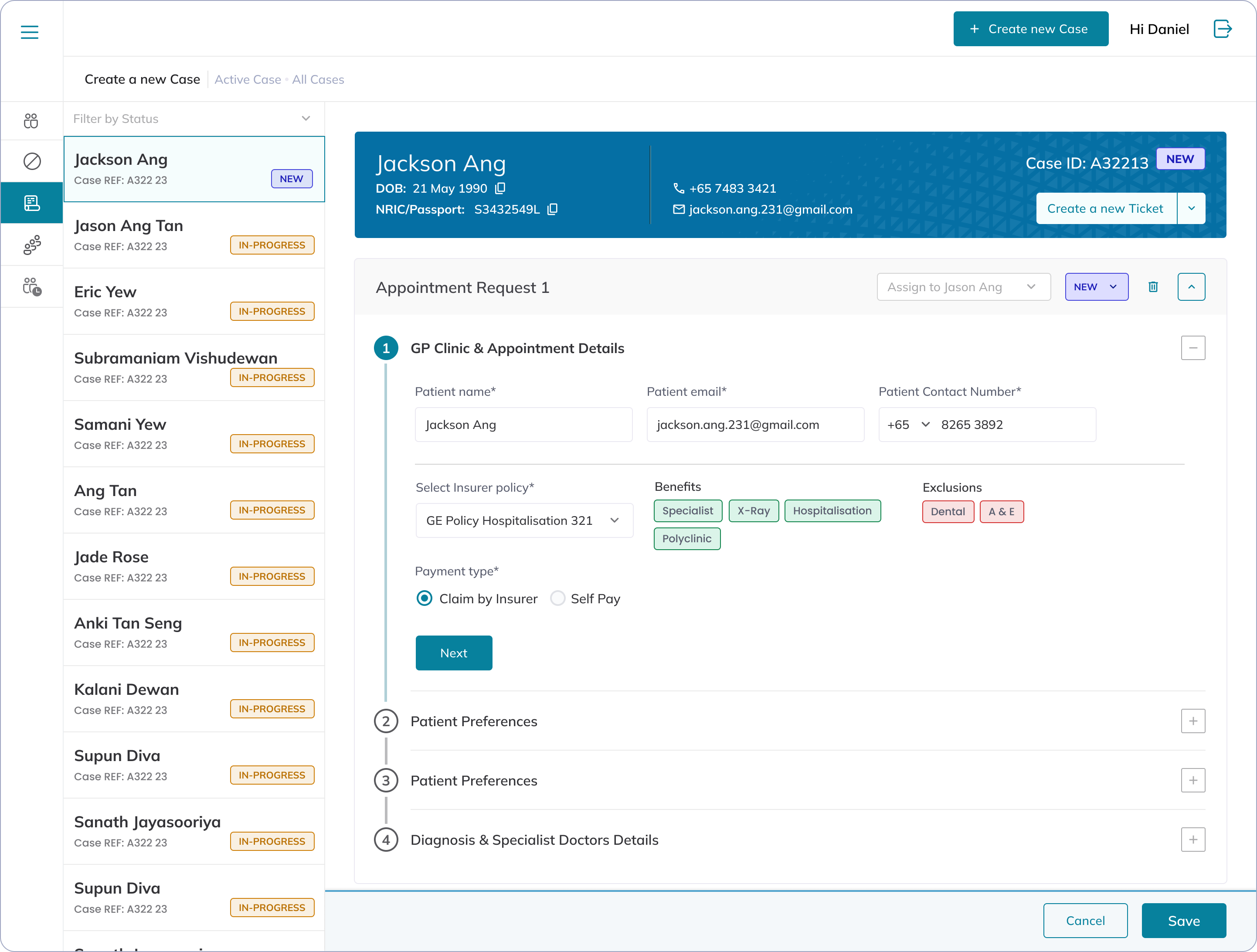
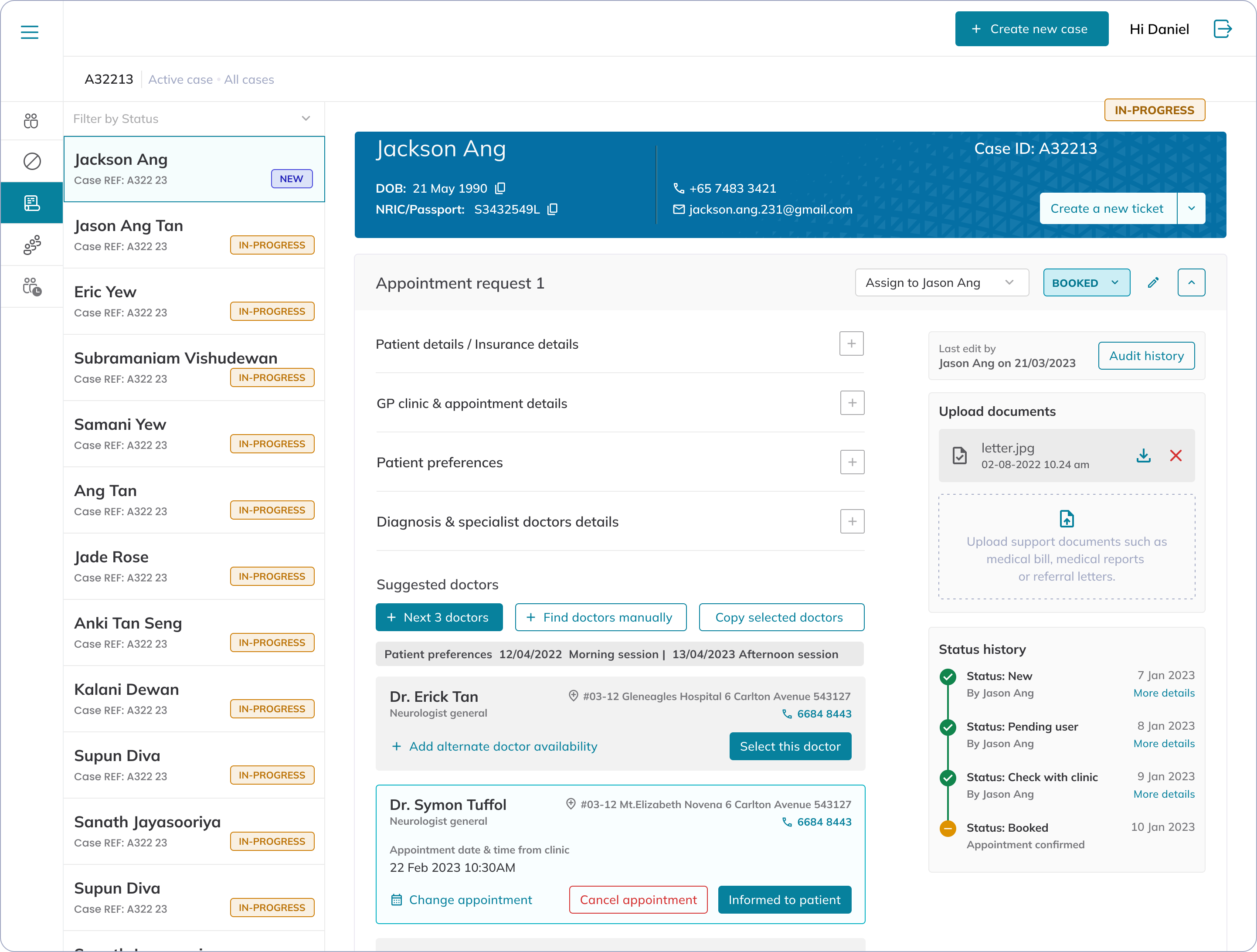
Using the design system, I built high-fidelity prototypes that streamline how agents manage and track cases. Each case contains multiple tickets — appointment requests or general inquiries — each with its own tailored workflow.
For appointment requests, agents follow progress through defined status stages and update details from patients and specialist clinics, covering the full GP-to-specialist flow designed for the MVP.
Unmoderated usability testing
I ran in-person unmoderated usability testing across 8 tasks, observing behaviour, collecting feedback and completing iterations. At the end, participants filled out the System Usability Scale.
What shipped, and what I took away
Next, we started the following phase — adding the de-prioritised “could-have” features and working closely with the data team to find behavioural gaps and improve them.
Extensive up-front research on the MCT flow surfaced the most critical features to focus on.
Working with developers throughout kept the design feasible within technical constraints.
Regular updates with clear reasoning kept every stakeholder aligned to launch.